Dillon County Court Records After Arrest
After a Dillon County arrest, the jail record and the court record separate. The booking record explains why a person entered custody and what the arrest paperwork alleged at intake. The court record shows what case opened, what charge was filed or pursued, what bond or hearing events occurred, and how each charge ended. The Dillon County Clerk of Court page says the Clerk serves Circuit Court and Family Court, manages dockets, receives criminal warrants in Circuit Court matters, receives bail, compiles trial lists, handles jury management, and maintains court records.
For bond, warrants, and early criminal procedure, the Dillon County Magistrate Office is central. The Magistrate page says magistrates set bail, conduct preliminary hearings, and issue arrest and search warrants. It also links to the Dillon County Public Index, which is the official court-search channel for case records. For General Sessions prosecution, Dillon County is in South Carolina's Fourth Judicial Circuit. The county Solicitor page identifies Paul M. Burch, Jr. as the Solicitor contact and describes the Solicitor as the chief prosecuting attorney.
Custody-side records belong with detention. For current jail status, use Dillon County jail inmate records. For booking-photo access, use the Dillon County jail mugshots page.
Find Dillon County Court Records
The Dillon County Public Index is the main online court case-search portal found in the research. It is linked from the Dillon County Magistrate Office page and is used for public court records, not live jail custody. Search by defendant name when the case number is unknown. If the name is common, narrow by court agency, filing date, case type, or other available filters.
- Open the Dillon County Public Index.
- Search by defendant name or case number when known.
- Review the court, filing date, case type, charge descriptions, and hearing entries.
- Compare booking charges with filed charges because they may not match exactly.
- For General Sessions cases, check Fourth Judicial Circuit Solicitor resources and court-date information.
- For older, sealed, juvenile, or missing records, contact the Clerk, Magistrate, Municipal Court, or Solicitor as appropriate.
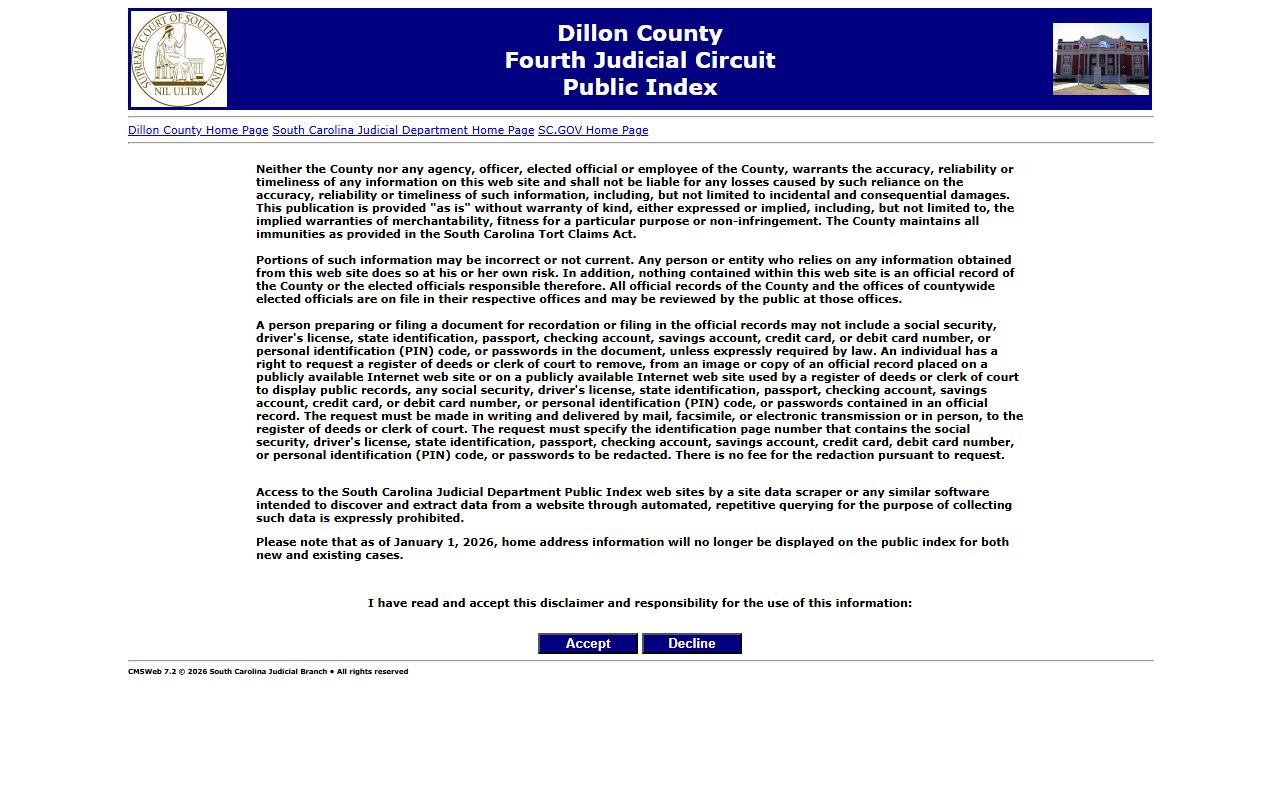
The official Public Index screenshot below shows the court-search route for Dillon County. It helps with court records after a jail arrest, but it does not confirm whether a person is still in the detention center.
Dillon County Public Index Fields
The Public Index search fields differ from jail roster fields. A court search usually works best with a case number or exact party name, while a jail custody check starts with the detention center. Public Index records can show criminal, traffic, civil, family, and other court categories depending on the case and court level.
| Field Label | Type | Required | Notes |
|---|---|---|---|
| County | Fixed site path | Yes | Dillon County Public Index path. |
| Court Agency | Dropdown/filter | No | Use to narrow Magistrate, Municipal, Circuit, or other court results when available. |
| Case Number | Text | No | Best when copied from paperwork or a court notice. |
| Party Name | Text | No | Search by defendant name. Spelling matters. |
| Date Filed | Date range | No | Narrows older or newer cases. |
| Case Type | Dropdown/filter | No | Criminal, traffic, civil, family, and other categories may appear. |
Dillon County Criminal Court Offices
Different offices answer different court-record questions after arrest. The Clerk of Court handles Circuit Court records and receives criminal warrants in Circuit Court criminal matters. The Magistrate Office handles bail, preliminary hearings, and warrants at the summary-court level. The Solicitor prosecutes General Sessions criminal cases in the Fourth Judicial Circuit. A municipal arrest in the City of Dillon may also have a municipal court stage before or alongside county-level processing.
Dillon County Clerk of Court
301 W Main St, P.O. Drawer 1220
Dillon, SC 29536
843-774-1425
Email listed by county: dccoc@dilloncountysc.org
Dillon County Magistrate Office
1033 Old Latta Highway, P.O. Box 1016
Dillon, SC 29536
843-774-1406
Hours listed: 8:30 am to 5:00 pm, Monday through Friday
Fourth Judicial Circuit Solicitor
1033 Old Latta Hwy, Suite C, P.O. Box 868
Dillon, SC 29536
843-774-1448
Prosecution office for Dillon County General Sessions cases.
Charges Filed After Arrest
A jail booking charge is not always the charge that appears in the court case. Law enforcement may book a person on an arrest charge, while the Solicitor later decides which General Sessions charges to pursue, amend, reduce, dismiss, or resolve by plea or trial. The Clerk receives criminal warrants and transmits them to the Solicitor in Circuit Court matters, and magistrates handle early bond and warrant issues.
| Document | Who Uses It | What It Does |
|---|---|---|
| Complaint or citation | Officer, court, or prosecutor depending on case type | Starts or supports a lower-court criminal or traffic case. |
| Information | Prosecutor | Formal charging document used when allowed by South Carolina procedure. |
| Indictment | Grand jury and prosecutor | Formal felony charging document in many General Sessions cases. |
The Public Index and court offices can show the filed court charge. The detention center can explain local custody status, bond receipt, and whether another hold affects release.
Dillon County Charge Status Terms
Court records after an arrest often contain short status words. They matter because a pending charge, a dismissed charge, and a conviction are not the same thing. A case can also move between summary court and General Sessions, or a charge can be amended as prosecutors review facts, evidence, witness statements, and legal elements.
| Status | Meaning in Court Records |
|---|---|
| Pending | The charge remains open and has not reached final disposition. |
| Amended or reduced | The charge was changed by prosecutor or court action. |
| Dismissed | The charge ended without a conviction. |
| Nolle prossed | The prosecutor declined to continue the charge. |
| Guilty or convicted | The court entered a conviction by plea, trial, or other valid proceeding. |
| Bound over | A lower-court matter moved toward General Sessions or Circuit Court handling. |
Bond Records After Arrest
Bond in Dillon County starts with South Carolina magistrate and court rules. The official Magistrate page says magistrates set bail, conduct preliminary hearings, and issue warrants. S.C. Code 22-5-510 says a person charged with a bailable offense must have a bond hearing within 24 hours of arrest. S.C. Code 17-15-10 and 17-15-15 address own-recognizance release and some cash-percent bond rules.
| Bond Type | How It Works |
|---|---|
| Personal recognizance | Release based on a written promise to appear, when the court allows it. |
| Cash bond | Money posted as ordered by the court or accepted by the facility. |
| Surety bond | A bondsman or surety posts bond subject to state law and court conditions. |
| No-bond hold | Release is not available unless a judge changes conditions or another hold clears. |
| Detainer | Another county, state, federal, probation, parole, or ICE hold may block release. |
Always ask whether another hold exists before paying bond. A second hold can keep a person in custody even after local bond is posted.
Dillon County Warrants and Arrest
No official Dillon County online active-warrant list was located on the Sheriff's Office page. The Sheriff page says one office function is serving and executing warrants. The Magistrate page says magistrates issue arrest and search warrants. The Clerk page says the Clerk receives criminal warrants and transmits them to the Solicitor in Circuit Court matters. Together, those sources show the path: a court or magistrate issues or processes a warrant, law enforcement executes it, the person may be booked into Dillon County Detention Center, and the court record carries the case forward.
- Arrest warrant
- Judicial authority for law enforcement to arrest a person accused of an offense.
- Bench warrant
- A warrant issued by a judge, often for failure to appear or failure to comply.
- Search warrant
- Authority to search a place, vehicle, device, or item. It is not a jail record by itself.
- Fugitive or hold warrant
- A notice that another jurisdiction may want custody or pickup.
Charges Versus Convictions
Court records after an arrest should be read with care. A charge is an accusation or filed count. A conviction is an outcome after a guilty plea, verdict, or other court action. Public records can show both, but they should not be treated as the same thing. Court dockets may also show dismissed or nolle prossed charges that did not end in conviction.
| Record Point | Charge | Conviction |
|---|---|---|
| Stage | Accusation or filed count after arrest. | Final guilt finding or plea outcome. |
| Proof | Based on arrest paperwork, warrant, citation, indictment, or prosecutor filing. | Requires court disposition under criminal procedure. |
| Public meaning | Shows case activity, not guilt by itself. | Shows a criminal judgment unless later vacated or expunged. |
Sealed and Expunged Arrest Records
South Carolina expungement law matters when a Dillon County arrest does not lead to a public conviction or qualifies for later record clearing. S.C. Code 17-1-40 addresses arrest records, booking records, bench warrants, mug shots, and fingerprints after eligible expungement situations. The law provides for destruction or sealed retention, and sealed information is not public except by court order.
| Issue | Sealed | Expunged |
|---|---|---|
| Public visibility | Hidden from ordinary public access. | Destroyed or retained under seal as allowed by law. |
| Effect on mug shots | May block public access if covered by a valid order. | Eligible mug shots and booking records must be destroyed or sealed under the statute. |
| How to verify | Check the court order and clerk record. | Check expungement eligibility and order status through the proper court or solicitor channel. |
Juvenile records, sealed records, expunged records, medical information, and active investigative material may not appear online. South Carolina FOIA also allows law-enforcement exemptions for safety, privacy, fair-trial, and investigative reasons.
SLED Criminal History Checks
The SLED CATCH portal is the statewide South Carolina criminal-history search route. It is not a Dillon County jail roster and it is not the same as a Public Index case docket. Ordinary users generally pay a fee, and the official SLED CATCH paper form lists the standard fee as $25 unless reduced-fee eligibility applies.
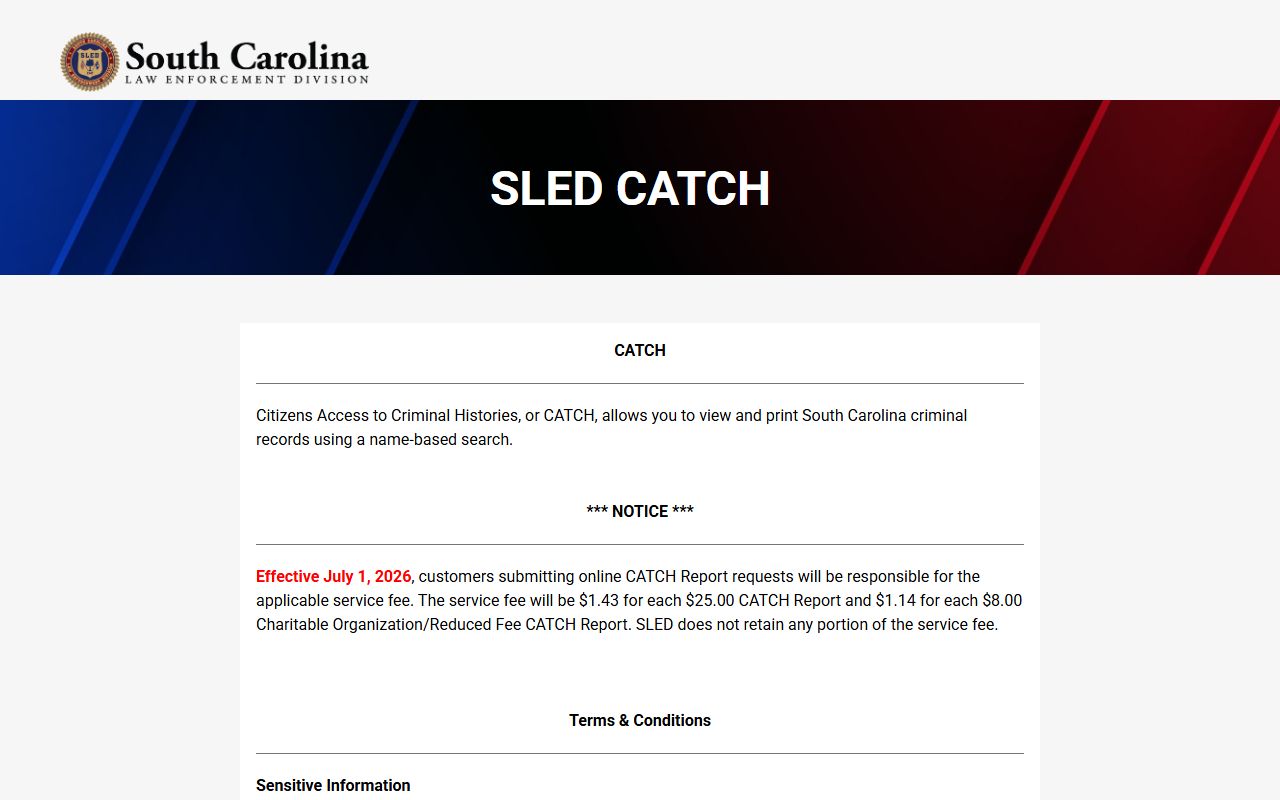
The SLED CATCH screenshot below shows the statewide criminal-history channel. It can help with broader South Carolina arrest or conviction records, while the Dillon Public Index remains the local court case-search path.